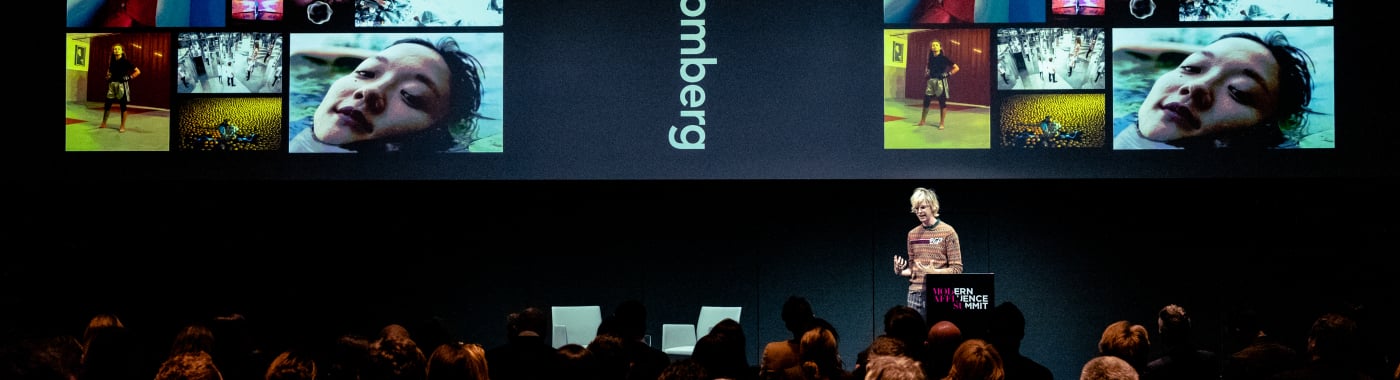
The Modern Affluence Summit
Tucked away just down from Cannon Street station sits the new Bloomberg offices, one of the most sustainable office buildings in the world where we gathered for Keko London’s Modern Affluence Summit.
Izzy Ashton
Deputy Editor, BITE CreativebriefTucked away just down from Cannon Street station sits the new Bloomberg offices, one of the most sustainable office buildings in the world and it’s where we gathered for Keko London’s Modern Affluence Summit in partnership with Adoreum & Partners, VICE and Bloomberg. With 67.4% of global wealth now being ‘self-made’ or ‘entrepreneurial’, the summit’s intention was to re-examine what affluence means to a modern consumer.
Consumer’s needs and behaviours have changed considerably over the last few decades, as Phil Robinson, EMEA Head of Data and Insight at Bloomberg Media so outlined in his opening talk. He spoke about the experience economy, highlighting research undertaken by Bloomberg and Credit Suisse across nine countries; 73% of affluent millennials value experience over material possessions. He also examined the rise of personalisation, revealing that 78% of the same consumer base would pay more for a personalised experience, using Atom Bank as an example of a brand doing this well.
One major focus of the morning was around sustainability and the affluent consumer’s desire for it; 75% will pay more for sustainable or socially conscious brands according to Bloomberg’s research. Dolly Jones, Chief Content Creator at Eco-Age spoke about how we are in an “era of activism [where] the ultimate luxury these days is a good conscience.”
Robinson said how a restless desire to do better is at the core of an entrepreneurial mind. This was personified by Dominic McVey who concluded the morning with a passionate call to arms for businesses to operate ethically and with integrity. As he said, “stop promising the world and delivering an atlas.” He revealed that his business is only doing better and making more money by doing it right. If you don’t, you will be caught out, citing a survey by Accenture that revealed 71% of young consumers believe that refusing to buy a brand’s product or criticising them on social media can make a difference in how companies act.
For the modern affluent consumer and the brands that they buy from, it is bravery that sits at the heart of success. Robinson put it plainly: “There are two types of bravery. The courage to ask questions and think, and then that which is needed to act and face the truth.”
SPEAKERS
Phil Robinson, EMEA Head of Data & Insight, Bloomberg Media
Thomas Benski, CEO & Co-Founder, Pulse Films
Emily Bromfield, Consultant CMO to One Luxury Group
Bunny Kinney, Global Editorial Director, Dazed Media Group
Ron Timehin, Photographer & Sony Imaging Ambassador
Dolly Jones, Chief Content Creator, Eco-Age
Dominic McVey, entrepreneur
KEY TAKE OUTS
- Phil Robinson spoke about brand value alignment; 64% of affluent consumers believe they are belief driven consumers.
- Change is intimidating for luxury brands as Dolly Jones revealed. But with this change comes a “chance to lead the wave, not just ride it.”
- Emily Bromfield, consultant CMO to One Luxury Group talked us through how to build a beauty unicorn. For her, the future for beauty lies in the “no-brand brand” one that is totally personalised and tailored for you; the “Monzo Bank of beauty.”
- The reality is that “advertising has for too long masked human reality, that we’re not perfect,” said Thomas Benski, CEO & Co-Founder of Pulse Films. For Benski, he wants to put braver people in charge, to promote greater collaboration and “create content that has a chance to cut through.”
- For Phil Robinson there is one motivation at the core of what it is to be an entrepreneur: “Any rule we invented, we can change.”