Loading...
Loading...
Trend

Social creativity is shifting from volume to value

Brands must keep up with maturing algorithms and take a quality over quantity approach to social.

Stephen Taylor

Social Lead Dinosaur

Share


For a long time, social media success looked like a volume game, more posts, more formats, more variants and more optimisation. The logic was simple: feed the machine and it will feed you reach. That model is now quietly breaking down.

Today, much of the technical advantage brands once competed on has been absorbed by the platforms themselves. Targeting is automated. Bidding is automated. Optimisation is automated. Testing frameworks are built in. ‘Best practice’ is templated and pushed by the tools. The mechanics are increasingly handled for you. Which sounds efficient - until you realise it also makes everything start to look the same.

Scroll any feed and you’ll see technically correct content everywhere: well-formatted, well-timed, platform-compliant - but instantly forgettable. When everyone is running on the same systems, differentiation can’t come from setup. It has to come from substance. This is why social creativity is shifting from volume to value.

Industry effectiveness research has pointed in this direction for some time. Creative quality consistently outperforms media weight alone when it comes to recall, brand lift and long-term effectiveness. What’s changed is that platform automation is now making that truth unavoidable. When delivery is handled by algorithms, the only remaining competitive edge is having something worth delivering.

When everyone is running on the same systems, differentiation can’t come from setup. It has to come from substance.

Stephen Taylor, Social Lead, Dinosaur

And that puts creative thinking - not just creative production - back at the centre.

There’s also a trust dimension emerging alongside this shift. As AI tools become more embedded in content creation and distribution, audiences are becoming more sensitive to what feels generic, synthetic or system-generated. We’ve seen very public examples recently of AI systems producing and distributing harmful or inappropriate content at speed, such as the recent Grok mishap, which has sparked broader debate about safeguards, responsibility and oversight. Without getting lost in the technicalities, the takeaway for brands is simple: people are paying closer attention to how content is made and why it exists.

Which makes human intent, judgement and craft more, not less, important.

Automation is incredibly good at scaling patterns; it is not good at creating emotional truth. That still lies in human creation. It can optimise variations, but it cannot originate cultural meaning. It can multiply outputs, but it cannot decide what is worth saying in the first place.

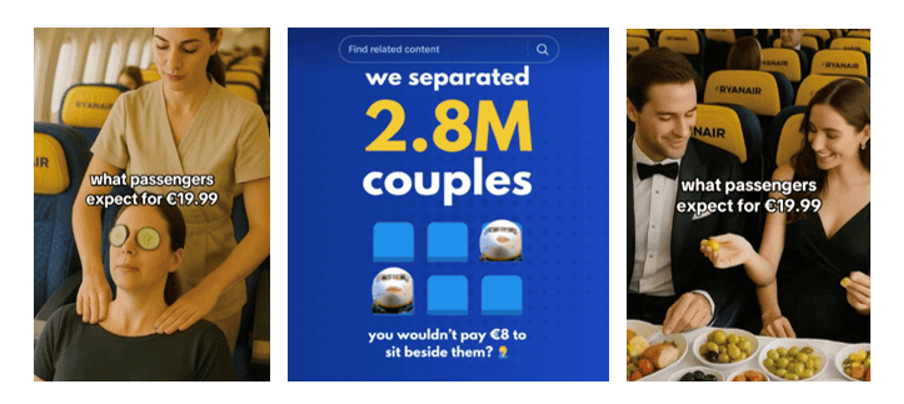
That’s why we’re seeing a second-order effect: the brands cutting through right now are not necessarily the most active - they’re the most distinctive. They build content that travels because it genuinely connects with people, thinking in stories rather than post counts, and design for resonance rather than just reach. Take Ryanair’s social strategy as an example, instead of following the usual airline playbook of polished, corporate messaging, they chose a different route - leaning into humour and a bit of self-awareness. It wasn’t the obvious move for the category, but it worked because it felt human. Rather than investing in glossy production or heavy campaign rollouts, they built attention through quick, reactive, platform-native content - often playfully roasting its own reputation or customer complaints. Their team works at the speed of culture: see a trend, agree on the Ryanair take, and get it live. No overcomplication, no layers of approval - just a clear voice and the confidence to use it.
Dino1.png

This leads into how we should think about efficiency. Producing more content more cheaply sounds productive, but if that content leaves no trace, no memory, no feeling, no association, then it isn’t efficient at all; it’s just cheaper noise.

There’s a useful creative discipline emerging here: fewer, sharper ideas. Work with a point of view that’s built to be clipped, shared, referenced and remembered, and that understands culture, not just format. The work we delivered for Pets at Home’s shift in organic social brings this approach to life. Instead of flooding feeds with product posts and offers, the focus moved to a simpler, human question: how do we reflect the nation’s love for their pets? The answer was fewer, more relevant pieces built around real-world vox pops - warm, funny and emotional moments from pet owners. The result was a four-part monthly series that prioritised shareability over promotion, lifting average views from around 36,000 to 109,000 per post. Proof that distinctiveness beats frequency.

For agencies, the challenge is simple: don’t become optimisation factories. The real value isn’t how many variations you can produce, but whether the idea behind them is strong enough to matter. For brands, that means asking a harder question before the performance one - not just “Will this convert?” but “Will this connect?” Because connection is what makes conversion compound. If you halve your volume but double your distinctiveness, will your results really suffer or improve? In a world where the algorithms handle the distribution, the brands that win will be the ones that give people something genuinely worth remembering.

Guest Author

Stephen Taylor

Social Lead Dinosaur

About

Stephen is a digital specialist whose deep expertise in social media leadership drives transformative, results-focused campaigns. Prior to joining Dinosaur, he honed his craft across the Australian and UK markets at McCann and Omnicom, developing a keen eye for creating standout social-first strategies. At the forefront of the ever-evolving social landscape, Stephen has led teams to deliver high-impact campaigns for brands across the automotive, travel, FMCG, and ecommerce sectors. His work has helped shape campaigns for household names including Volkswagen, Virgin Atlantic, Diageo, Pets at Home, and Bupa. Recently, Stephen’s focus has expanded to include organic social, influencer strategy, and the seamless integration of media, creative, and data to deliver innovative, results-driven campaigns for clients. His passion for pushing boundaries ensures clients benefit from strategies that are engaging and deliver measurable success.

Related Tags

Social Media