
Trend
The benefits of long-term partnerships in a fragmented market
Tom Ironside and Jen Wong share insights from twenty years of working together.
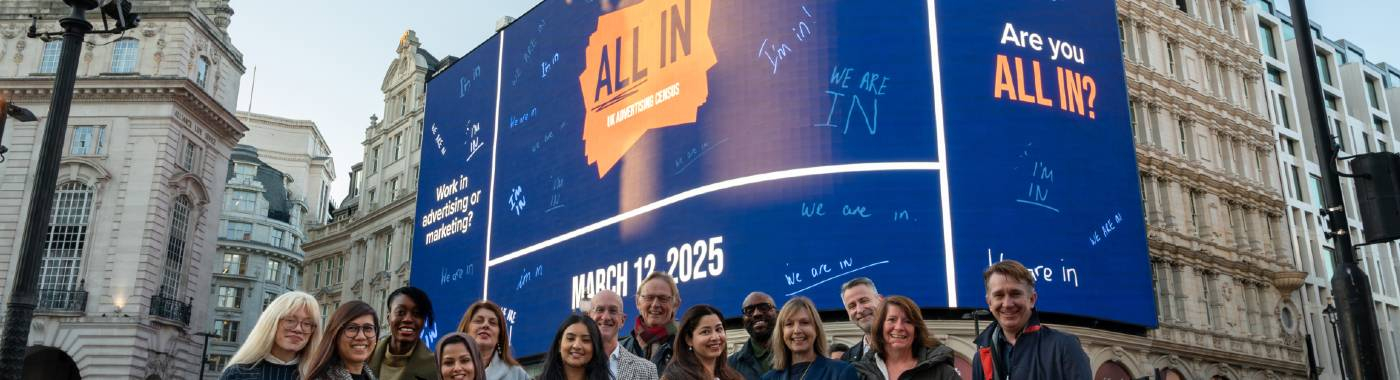
Everything you need to know about the third edition of the All In Census.

“We always knew this would be a marathon not a sprint.”
Speaking at News UK’s London headquarters, Kathryn Jacob, Chair of the Inclusion Working Group, underlined that building a more inclusive industry is always a work in progress. This focus on going further, not just faster, will be key to maintaining momentum on inclusion, with 148 companies across the industry signed up as All In Champions, action was front of mind for supporters.
Jacob paid tribute to the industry for embracing the third iteration of the All In census. She credited Sharon Lloyd Barnes, Commercial Director and Talent and Inclusion lead at the Advertising Association, for being the wind beneath the ambitious initiative’s wings.
While the number of respondents participating in the census has decreased, it remains one of the largest industry surveys. With over 14,000 respondents to the survey, it remains a must-read for anyone who works in the creative, marketing and media industries.
Deep dives into the intersectionalities of the data will be ongoing. As with previous iterations of the survey, the first cut of data is just the start, with the insights providing the launch pad for new All in Action plan recommendations to continue to shape a more inclusive and dynamic industry.
So, with the innate understanding that this is just the start of the next chapter of All In, here is everything you need to know about the survey today.
While respondents to the census focused on the positive impact of hybrid working on productivity and work-life balance, industry headlines continue to focus on one-size-fits-all return to office mandates.
The ongoing response to WPP’s 4 day a week return to office mandate underlines that hybrid working remains one of the most polarising conversations in advertising.
The All in Census provides an invaluable tool in this seemingly never-ending debate because the data is rooted in facts, not feelings. The data overwhelmingly showed that practitioners across the advertising and marketing industry, spanning agencies, media owners, tech companies and brand marketing teams, value hybrid working.
Notably, the research revealed that 58% of respondents felt that hybrid working has led to an increase in productivity. While 59% felt it had led to an increase in work/life balance. 35% felt it had led to an increase in meeting customer needs. Meanwhile, 31% thought it was contributing to less work burnout or fatigue.
The research also underlined the disconnect between what employees want and what some employers are offering. On average, respondents are working 2.6 days in an office, 2.2 days at home and 0.3 days in other spaces, such as clients’ offices.
However, the preferred number of days respondents would like to work in the office is 2.1 days a week, with 2.5 days a week at home and 0.4 days in other locations.
2025 marked the first time the All In Census has investigated employee engagement, with the results pointing to scepticism and a lack of trust in advertising.
While advertising industry commentators have long scoffed at the importance of purpose in marketing, the universal truth remains that people who care about what they do are the ultimate competitive advantage.
Through this lens, the survey raises some important tension points for the industry. Just 40% of respondents feel that advertising is a trustworthy industry to work in. While 44% of respondents believe that advertising has a positive impact on society.
The industry has a relatively low Employee Net Promoter Score of 6%, underlining there is more to be done to restore pride to the industry and redefine the creative firepower of the UK industry more broadly.
The census underlines that the industry is still treating older talent as if they have an expiry date.
15% of 55 to 64 year old’s in advertising have experienced age related discrimination, according to the All In Census. This uncomfortable truth underlines the fact that the industry does not reflect society. Just 0.4% of respondents to the All in Census were aged over 65. While 5% were aged between 55 and 64. The challenge will be how the industry commits to turning the tide on age-based stereotypes across the industry. The IPA’s latest research report, Time For Some New Age Thinking, which was unveiled at the IPA Talent & Diversity Conference last week, is a great place to start.
In an industry where who makes the work shapes the work, there is still more to be done to address the elephant in the room: class.
Working class people continue to be underrepresented in the industry, making up just 19%. A significant disconnect when working class people make up 40% of the UK population. In contrast, almost the same percentage of people (18%) in the industry attended a fee-paying school, compared with 8% of the population as a whole.
Dan Wilks, Director of the advertising industry think tank Credos, explained: “People from a working class background are the most underrepresented in our industry. If we are serious about representation, we must address this.”
The census reveals that Black, Asian and Muslim talent are most likely to have experienced discrimination.
The research underlined the importance of industry organisations such as MEFA and Join Our Table. Black respondents were the most likely to have experienced discrimination at 16% of respondents, followed by 12% of Asian respondents and 12% of Muslims.
Despite the deluge of negative headlines, the research revealed that the majority of employees are enthusiastic to use AI more in their roles.
This year’s All In Census took a deep dive into the impact of AI on the workforce and the results were largely positive. While there is concern in some disciplines such as programmatic advertising that AI is coming for your job, 63% of respondents felt enthusiastic to use AI more in their roles. 44% of respondents agree that AI has made them more effective in their jobs. While 41% use Generative AI to complete tasks fairly frequently.
Over a quarter of people are looking for a new job in order to earn more money, the ongoing impact of the cost of living crisis cannot be ignored.
While those endless headlines on the great resignation are now in the rear-view mirror, the All In Census underlines that talent is still heading for the exit doors, with 26% of respondents likely to leave their company in the next 12 months.
At a time when Trans people are facing the sharp edges of a political climate that keeps telling them they shouldn’t exist, All In shines a light on the Trans experience.
60% of Trans people have been made to feel uncomfortable in the workplace. 42% have experienced sexual discrimination. Over half (51%) of people feel they belong at their company. The work of Outvertising will be increasingly important in ensuring that the industry can work to create a more inclusive and welcoming space for the Trans+ community.
The census reveals that disabled people are still experiencing discrimination due to disability.
72% of disabled respondents feel supported by their company. Yet there is still further to go on this journey of inclusion. The Census reveals that 16% of disabled respondents are likely to leave the industry due to a lack of inclusion and discrimination. While 8% have experienced discrimination due to disability.
The work of NABS continues to be vital as employees grapple with workplace stress and mental health issues.
31% of respondents to the survey were affected by stress and anxiety. For 14% of respondents, their stress and anxiety was primarily work related. Stress and anxiety is disproportionately impacting younger talent, with 36% of 25 to 34 year olds impacted versus 25% of 45 to 54 year olds.
Work related stress was higher amongst disabled and LGBQ+ talent at 23% and 19% respectively.
In a year of economic and emotional challenge, the All In Census reveals that the majority of people like working in the advertising industry.
78% of All In respondents enjoy working in the advertising industry.
Work joy remains possible.
Looks like you need to create a Creativebrief account to perform this action.
Create account Sign inLooks like you need to create a Creativebrief account to perform this action.
Create account Sign in