‘Be bold, be vulnerable, be better’
Jon Evans and John Amaechi OBE on how advertising can eliminate harmful stereotypes.

Georgie Moreton
Deputy Editor, BITE CreativebriefEarlier in the year, Netflix’s Adolescence made headlines and thrust the issue of masculinity into the spotlight. For many young people, masculinity is in a state of crisis. A lack of positive representation in mainstream media, combined with a toxic social media underground of toxicity is leaving young people overwhelmed and confused.
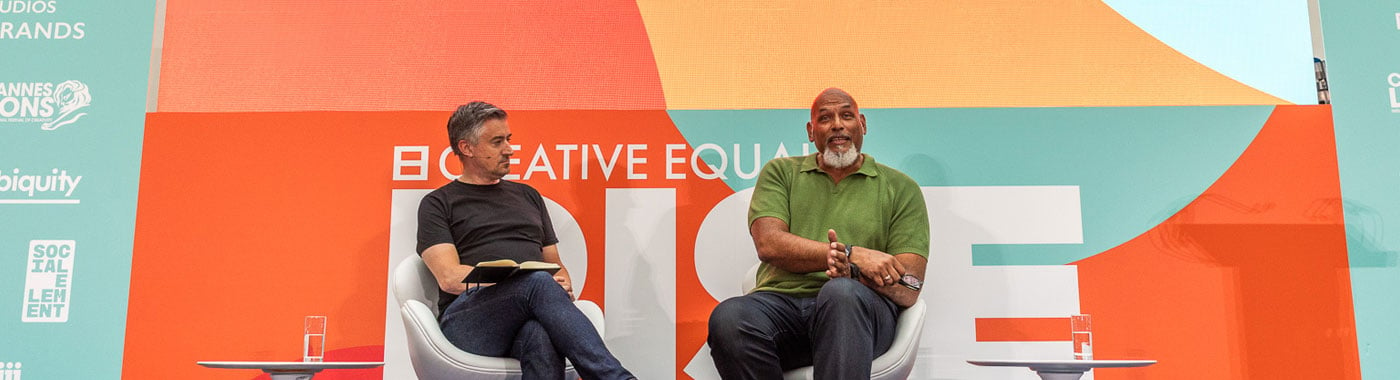
At Creative Equals’ RISE, Jon Evans, host of the Uncensored CMO podcast and John Amaechi OBE, Organisational psychologist and Founder of APS Intelligence, shared their thoughts on masculinity and the power of advertising to eliminate harmful stereotypes.
When it comes to masculinity, sport can be a platform for positive representation. In basketball, Amaechi competed in a very male sporting environment often associated with toxicity. Amaechi shuns negative stereotypes. He explains, “Sports at its best is a palace where you can find solace, a home, somewhere to feel safe. As a 6’9 Black kid in Stockport, it was a home for me,” he says.
“People talk about masculinity in sport. But I don’t know why people talk about sports as masculine. It makes me wonder what gaze you are using to watch sport,” Amaechi adds.
Rather than a breeding ground of hyper masculinity, Amaechi points to the fact that sport can be a place where masculinity is multifaceted. It allows for an outpouring of emotion that men might otherwise feel they need to repress.
“It is one of the few places where intimacy rules are suspended for men,” he says. He explained that in sport in celebration, men jump on one another and kiss, when they lose, they can hold each other and cry. When sport is done well, it is an example of relationships, intimacy and togetherness.
Being persecuted has never been a license to traumatise other people.
John Amaechi OBE, Organisational psychologist and Founder of APS Intelligence
Redefining masculinity
“The bar seems to be very low on male emotional literacy,” says Amaechi. “We are missing a trick. The definition of masculinity needs to be broadened.”
“Masculinity is not a place of machismo or a thing of stoicism. There is a place for you in the spectrum of masculinity,” he says.
So, what is holding men back? Amaechi’s answer: Men. He explains: “There are lots of people who talk about this issue as if it's the fault of women. They say things like most men have to swipe 100 times on Tinder before they get a date.” Amaechi seeks to define masculinity in other ways, urging that it should not exist only in relation to women.
Amaechi urges young people not to follow negative influences online and the ‘abhorrent form of masculinity.’ “It will lead you only to pain,” he says. Instead, he urges men to look around at the people in their lives and take advice from loved ones and from women.
“If the power of your pack at the pub can force you to conform to this toxic form of gender identity, then you have bad friends. You need to think about your will, and you have bad role models too,” he adds. Continuing: “Being persecuted has never been a license to traumatise other people.”
Masculinity is not a place of machismo or a thing of stoicism. There is a place for you in the spectrum of masculinity.
John Amaechi OBE, Organisational psychologist and Founder of APS Intelligence
System1’s Feeling Seen research found that when people see themselves in advertising, they feel more positive. There’s a powerful connection between how you feel and how you behave.
In further research, they uncovered that it's not just by being seen but in how people are being seen. “The way we communicate is not connecting with young men,” says Evans.
People can see through inauthentic representation. “We can do better than contrived archetypes,” said Amaechi. Instead, he urged brands to capture the moments and the feelings that men feel when they are together, the subtle, intimate moments and signals that tell them they are understood.
To marketing leaders, Amaechi says: “You’re going to get shit no matter what you do. But you will not get the people you think you get by showing a watered-down, non-nuanced, superficial description of who we are. You’ll lose both sides, be bold, be vulnerable, be better.”
Photo Credit: Bronac McNeill