Channel 4’s marketing chief on why a first isn’t enough
Amber Kirby, Marketing Director at Channel 4, on why the broadcaster’s approach to marketing the Paralympics is a long-term journey.

Nicola Kemp
Editorial Director Creativebrief“Change is a long journey, it does not happen with just one thing.”
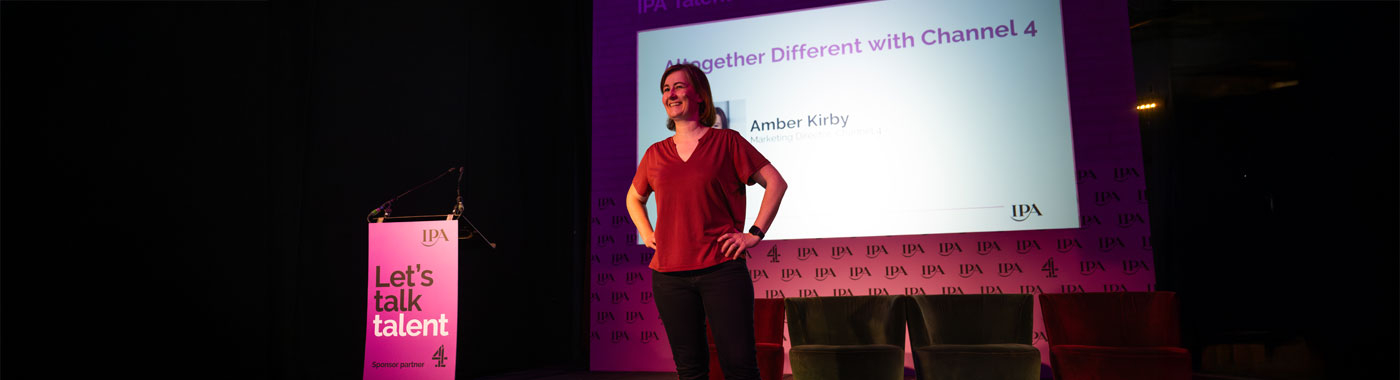
Amber Kirby, Marketing Director at Channel 4, is explaining how the broadcaster’s approach to the Paralympics is a long journey of adapting and learning.
Speaking at the IPA’s Talent & Diversity conference, Kirby lifted the lid on the marketing learnings from the broadcaster’s long standing commitment to the Paralympics. In a marketing ecosystem in which it is increasingly difficult for marketing leaders to invest in long-term brand building, Channel 4’s Paralympic campaign underlines the power of playing the long game.
“Creating change through entertainment is the purpose of Channel 4,” explained Kirby. She shared that this ethos means the broadcaster can challenge, push boundaries and be provocative in its marketing approach.
We never stand still.
Amber Kirby, Marketing Director, Channel 4
An ongoing obsession with accessibility
“We never stand still,” she shared, adding: “From the way we go to market, to our content, we absolutely want to make sure that everything in media and broadcasting is more and more accessible.”
To this end, in 2022, the broadcaster launched its disability code of portrayal outlining what makes nuanced, real and authentic representation.
The broadcaster’s coverage of the Paralympic Games has been an important part of this journey. A journey which began in 2012 with the iconic London Games.
According to Channel 4’s research in 2012 just 14% of UK viewers said they were going to watch, or were thinking about watching the Paralympic Games.
In this low awareness market the broadcaster launched ‘Meet the Superhumans’, a campaign which successfully raised awareness of the games. In the wake of the hard-hitting campaign, 69% of viewers said it was the first time they had made an effort to watch the Paralympic Games.
Yet while the campaign made a big impact on audiences, Kirby shared that there was pushback from viewers on the grounds of the ‘misguided’ superhuman archetype which left some uncomfortable. While feedback from the athletes themselves focused on the fact that they wanted to move beyond the ‘Superhuman’ badge and simply be athletes.
Moving beyond the Superhuman stereotype
A universal danger in inclusive advertising is simply replacing one stereotype with another. So in 2016, when the games returned in Rio, Channel 4 didn’t simply return to the same narrative.
“Our new approach was not just about putting athletes on pedestals; we wanted to move beyond that,” explained Kirby.
The ‘Yes I Can’ campaign was uplifting and full of joy. According to Channel 4’s research, 79% of people said that it improved society’s perception of disabled people.
Yet the narrative that there is ‘no such thing as can’t’ also provoked a thought-provoking push back from some viewers. As Kirby shared with the audience, the joyful accessibility depicted in the advert didn’t reflect the lived experience of viewers. With one commenting that the spot ‘puts me to shame that I have no talent’ and another simply declaring: ‘sometimes we can’t’.
Our new approach was not just about putting athletes on pedestals; we wanted to move beyond that.
Amber Kirby, Marketing Director, Channel 4
The ethos that sometimes you can’t lay at the heart of the creative development for the campaign for the delayed Tokyo games.
Made by Oscar-nominated cinematographer, Bradford Young, the ‘Super.Human’ campaign explored the sacrifices made by Paralympians to pursue their dream of being champions.
It marked a step change from previous campaigns because it focused on the fragilities and the everyday struggles of the athletes. Placing their humanity front and centre.
The script was written in partnership with the athletes and graphically depicts the gruelling challenges they face, accompanied by a sucker punch of a headline declaring: ‘To be a Paralympian there’s got to be something wrong with you.’
As Kirby explained, the approach was rooted in the desire for honesty. “We were not casting them as superheroes who can do no wrong,” she says.
Notably, the campaign highlighted the everyday moments of causal exclusion that disabled people navigate every day, such as not being able to get into a coffee shop because there is no ramp.
The campaign was supported by punchy out of home ads declaring: ‘It’s rude not to stare.’
Once again, the adverts garnered both praise and pushback. With one viewer complaining that the campaign was ‘Absolutely vile and the content is sickening.’
In 2024, Channel 4 turned the lens on the viewers themselves, with a standout campaign for the Paris Olympics titled ‘Considering What.’
The campaign was rooted in research commissioned by Channel 4, which showed that 59% of people said they watch the Paralympic Games to ‘see athletes overcoming their disabilities’. In contrast, just 37% say they watch the Paralympics for ‘exciting sporting competition’.
Rather than showing the athletes ‘overcoming their disabilities’, the campaign depicts Paralympians taking on and overcoming forces such as gravity, friction and time – that make no exception for any athlete, regardless of disability.
As Kirby explained: “This campaign really spoke not just to the Paralympic athletes but to the disabled community at large.”
Once again the campaign garnered a polarised response from viewers. Some praised the broadcaster for its commitment to inclusivity, while others were shocked by the violence in the advert.
Yet there is no debating the impact of Channel 4 on the Paralympics, with 85% on screen diversity in the presenting team and 7.3 billion minutes of viewing time consumed. 79% of viewers said it was as exciting as the Olympics.
A masterclass in progressive marketing, at a time when fear of backlash risks holding brands back creatively, Channel 4’s approach underlines the power of active listening and viewing marketing as a long-term journey.
It was a commitment that was commended by Leila Siddiqi, Director for Diversity and Inclusion at the IPA. “Channel 4 has a consistent commitment to fairness,” she explained, adding that the broadcaster’s work around the Paralympics is a ‘masterclass in how to use creativity for good.’
The next chapter of this masterclass is already in progress. Kirby shared that the team are not only on a constant countdown to the LA Olympics, but that they are constantly working on championing accessibility and inclusive sports.
As she explained: “There is not a minute when we are not thinking about it.” An approach which underlines that the very best marketing leaders recognise that creating industry leading work is forever a work in progress.