
Voices
Shortlist announced for tenth edition of Channel 4’s Diversity in Advertising Awards
AMV BBDO, Havas London, Leo UK and BBH are amongst the shortlisted agencies.
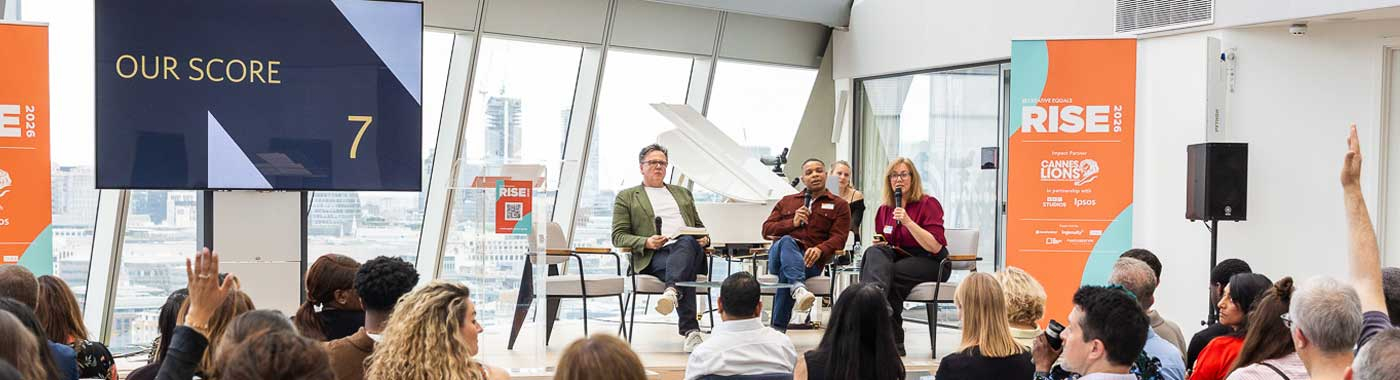
At Creative Equals’ RISE, speakers from Cannes Lions underlined the importance of healthy debate in driving creative excellence.

In the business of creativity, we all aspire to make work that is engaging, original and commercially effective. Yet what is considered creative by one person might not be considered creative by another.
At Creative Equals’ RISE conference, speakers from Cannes Lions explored the importance of having creative frameworks to be able to assess and discuss the work to help us make the work better. The correlation between award-winning work and commercial effectiveness can help us make the business case for creativity.
Jenni Middleton, Editor-in-Chief at Cannes Lions, hosted an interactive session that encouraged the audience to start thinking about how we assess creativity. Featuring Paul Kemp-Robertson, Chief Content Officer at Cannes Lions and Jason Edwards, Strategy Director at Creative Equals, the session explored how and why using creative frameworks can help create genre-defining work.
Creative ladders are ways of scoring creative work and take the heat out of debating creativity. They help bring brands and agencies together to discuss the work and use numbers and data to track something that can often feel subjective.
A lot of the best work doesn’t come from a comms brief but from a real need.
Jason Edwards, Strategy Director at Creative Equals
Kemp-Robertson shared that whilst working at Contagious, he helped to create a creative ladder with Heineken to help the company deliver consistently across its global brands. The 10-point scale was inspired by a framework he had used at Leo Burnett. The ultimate goal, as he explained, was: “Uniting a global company with a common language.”
The 10-point scale sees work scored by a number. At the low end, a work scoring a one or two is ‘destructive’, whilst a nine or a ten is ‘career-defining’ work. Kemp-Robertson explained that most work lands at the ‘middle of the scale’ and getting past a four is most important. A four on the scale means ‘cliche’, Kemp-Robertson shared that 80% of ads fall here.
Kemp-Robertson and Edwards explained that a creative scale is so important because it helps build a language of creativity. The scale can help marketers become more human, think like consumers and have the confidence to speak about creativity.
The interactive session invited the RISE audience to take part in creative debate, watch some work and rank it on the creative scale. The session underlined that healthy debate can help move work up and down the scale.
Edwards shared that for him, great work is built on insight and truth. “Tap into a truth and invest the audience to think about that thing in a different way,” he explained, adding: “A lot of the best work doesn’t come from a comms brief but from a real need.”
He also added that humour and lightness can help move work up the scale and increase virality. However, he acknowledged that for others, this may not be a factor. By sparking discussion, the scale can help people share their perspectives and broaden the creative lens.
Discussion and debate are essential in moving the dial forward. Understanding the opinions of others helps us to think differently and create more inclusive work.
If creativity is a muscle, we must continue to train it every day.
Photo credit: Bronac McNeill Photography
Creativebrief is proud to be supporting RISE with the free to access RISE Trend report. Please register to receive the report here:
Looks like you need to create a Creativebrief account to perform this action.
Create account Sign inLooks like you need to create a Creativebrief account to perform this action.
Create account Sign in