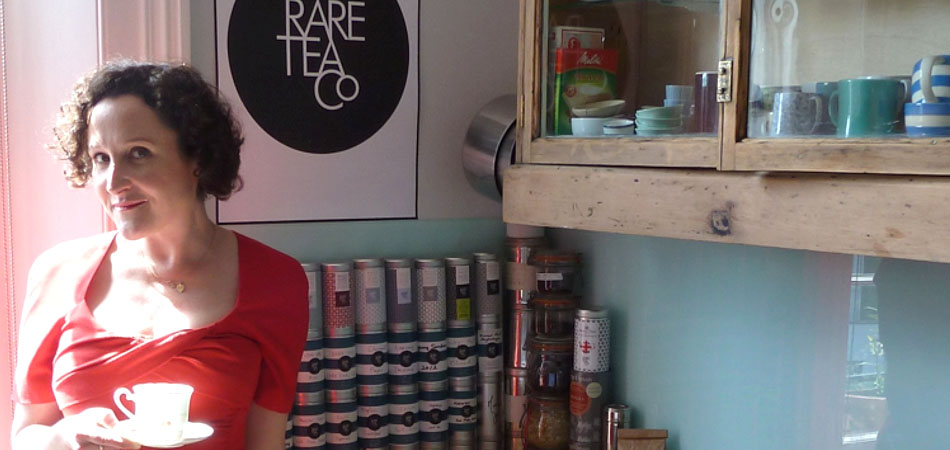
Creativebrief: Why Rare Tea?
Henrietta Lovell: It’s not that there is anything wrong with what we drink – it’s just that there is so much more out there. The incredible complexity of oolong, for example, amazes even Michelin starred chefs.
And this exhilarating new world of flavour isn’t restricted to exotic teas. My greatest love is making “ordinary” English tea into something extraordinary. English Breakfast doesn’t have to be a bland blend. It can be both reassuringly recognisable and surprisingly delicious.
What we think of as “normal” tea can hold such exquisite subtleties as to make you weep for the wasted years.
Where once we had only had granules we now have fragrant coffee beans. Beside malt vinegar in cupboards across the country there is wine, cider, sherry and balsamic. Where there was only vegetable oil the nation has embraced olive, sesame and groundnut.
Now it’s tea’s time.
Creativebrief: What does the Rare Tea Co. brand stand for?
Henrietta Lovell: First, please suspend your cynicism. We are very used to brands talking about passion when they mean pale enthusiasm and quality when they are really referring to passable mediocrity.
Rare Tea is not that kind of company.
Rare Tea stands for unparalleled tea.
I don’t believe there is another company anywhere selling better tea. I know that sounds like hyperbole. Of course I would say that, but I am willing to put my words to the test. You just have to taste it.
Tea can be produced and bought for a few dollars a kilo or for thousands. Just like wine it depends on the varietal; the terroir; the season; the growing conditions; the pH of the soil; when the sun first hits the bushes in Spring and, of course, how it is produced.
But unlike wine, where knowledge and expertise are often required to identify the good stuff, with tea we can all get it immediately. It just tastes better.
Rare Tea stands for our farmers.
Again you’d be forgiven for hearing marketing spieI here. It does sound a bit like spin, I admit. However, I travel the world to seek out independent tea gardens and farmers who still grow and craft their tea for its quality, not for volume or the lowest price.
We work with men and women who have inherited generations of workmanship and are fiercely proud of what they do. We deal with them directly and pay the price they need for their farms, and the people who live and work on them, to thrive.
I interviewed one of the farmers we work with for BBC Radio 4’s Food Programme. This explains direct trade in greater depth:
http://www.bbc.co.uk/programmes/b00pn410
Over the years we have built up a loyal following, often described as cultish.
Once you’re hooked on the good stuff there is no going back. Our customers believe in what we do and they love what they drink. I’ve been known to meet jonesing customers on street corners – desperate to replenish their stash.
Creativebrief: What are you doing that’s so different?
Henrietta Lovell: Almost everything.
The most obvious thing is that Rare Tea Company does not sell tea-bags. When I started the company in 2004 it seemed like madness to most people. With only about 3% cent of tea drinkers using loose tea why wouldn’t I sell bags?
But in 1968 only 3% of British households didn’t drink loose leaf. Things can change quickly. You just have to dare. And I do dare.
Rare Tea is not industrial grade teas stuffed in bags. There is no silken (read: plastic) pyramid nor a tag hanging menstrually from a string.
I would never compromise on flavour so I can’t sell bags. It’s not just effete snobbery – it brews better that way. Good leaf tea needs room to swell and unfurl as it infuses. An oolong, for example, might increase in volume twelve times as it brews. That would need a very big tea bag.
It’s not complicated to pop some leaves in a pot. We’ve been doing it for about 5000 years.
How to make a good cup of tea
It famously took the arrival on our shores of the cafetière to make people drink ground coffee at home. Most of us already have a teapot at the back of a cupboard.
It may take a minute or two more to brew a good leaf. You do have to pour the tea into a cup rather than fishing around with a teaspoon for a soggy bag and then dripping it to the bin. But that moment is a small ritual of pleasure.
A minute is not a burden even in our hectic lives. And if it is a minute that brings intense pleasure it must surely be worth it. I made a short film for the Guardian with a Buddhist nun explaining this: http://www.guardian.co.uk/lifeandstyle/video/2009/nov/27/tea-lady-cheese-buddhist-nun
Another point of difference is that I don’t buy from a broker. There is a proliferation of small tea companies that have mushroomed in the last few years. There are some excellent brands but the vast majority buy from the same international brokers. It’s a sensible policy in terms of stock control – you only buy what you need – but knowledge of farmers, processes and conditions is scarce. Buyers who use brokers are in those brokers’ hands when it comes to quality, while farmers are at the brokers’ mercy in terms of pay. Either end can get squeezed and very nasty.
I buy our tea directly from farmers. In this way I guarantee the tea from plant to cup. I can ensure quality and decent environmental and social conditions. But it does mean we have to buy whole harvests. Tea is a plant, of course, and it produces its best leaves at certain times of the year. We need to buy harvests from particular varietals, particular fields, harvested at particular times. We need to buy a year’s supply and guess on our growth margin (Restaurant sales in the last year rose 100%).
And no chemical flavourings. Not ever.