Creativebrief reveals rise of social-first marketing in new report
The Social Sells 2.0 report uncovers how senior marketing leaders are increasing investment in social media.
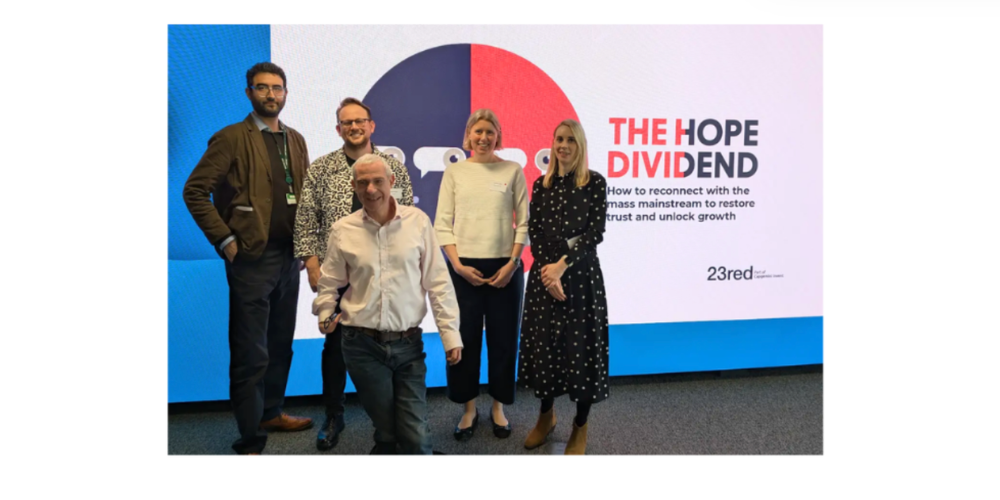
Industry leaders unpack how to make hope a tangible marketing strategy at 23red’s Hope Dividend event.
“We should not dismiss or treat the search for belonging as radical.”
At 23red, part of Capegmini’s The Hope Dividend event, Steven Lacey, Managing Director, The Outsiders, uncovered research that delved into some of the reasons why people who feel left behind are finding hope in the extreme.
In a fractured world, people feeling disillusioned can start with the small things. A pothole in a road, a scrapped bus route, a struggle to get a doctor's appointment. Lacey explained that these small things can ladder up to a lack of trust in society, which leaves people feeling powerless. Online, echo chambers and algorithms of anxiety validate and amplify these feelings of fear. Large numbers are turning inward to communities and away from national brands.
Yet, Lacey urged that instead of feeding fear and dismissing the masses that are disillusioned as radical, marketers must instead provide unity and hope by tapping into a system that creates belonging.
“People want to feel heard and want the small things fixed,” explained Lacey, adding: “The mainstream isn't radical, but it is largely lost.”
In turbulent times, audiences need hope more than ever. Speaking with optimism alone is not enough. “Hope requires problem and solution,” Lacey explained. Hope is not an idea; it is practical, tangible and actionable. In harnessing hope, brands are able to better connect with mass mainstream audiences.
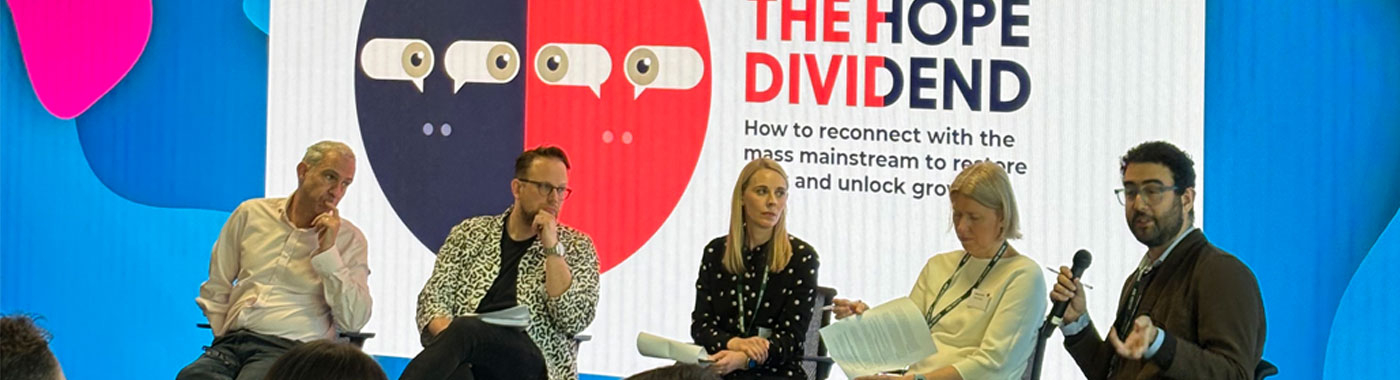
A panel session hosted by Lizzie Haycocks, Strategy Director at 23red, saw Simon Mutter, Strategy and Planning Partner at 23red, Steven Lacey, Managing Director at The Outsiders, Kathleen Smit, Deputy Head at Health Equals and Ben Shimshon, CEO of Thinks Insight and Strategy, share how brands can speak the language of hope. The session was grounded in the 23red Collective approach of looking to specialists to tackle challenges that are too big for any one organisation to solve alone.
At a time when there is a huge amount of negative news, 23red’s Strategy and Planning Partner, Simon Mutter, encouraged marketers to ‘compete for the light.’ Thinking of hope through the lens of a tangible structure; namely a problem with a clear solution, he shared that it is a marketer’s role to ‘offer a pathway to change’.
Compete for the light.
Simon Mutter, Strategy and Planning Partner, 23red
While it's easy to see the news cycle and think it is all doom and gloom, Ben Shimshon, CEO at Thinks Insight and Strategy, shared that while the nation’s outlook has been negative for many years, people are more likely to be optimistic about their own lives and local area. “‘Most people think they are trying and doing the right things and see their achievements as a result of that hard work,” he explained.
For brands, tapping into this optimism means finding a way to speak about things people are familiar with. “We feel more control about what’s closer to us,” Shimshon shared.
Finding local ways to help people connect with national issues, Kathleen Smit, Deputy Head at Health Equals, shared how Health Equals’ Hazmat Loungewear helped bring people into making systemic change by making a large issue tangible.
The campaign honed in on the relatable issue of damp and mould in the house to show audiences that health inequality is not pie in the sky. A localised postcode checker allowed people to understand the impact on them and email a local MP. The campaign created the fake product of a hazmat loungewear suit to dramatise the issue, pulling on the absurd to bring people into the powerful story, but without a feeling of worthiness.
Listen to the people you want to tell stories to.
Ben Shimshon, CEO of Thinks Insight and Strategy
“Hope needs to have a clear enemy or problem,” explained Lacey. At a time when people don’t trust national institutions, a worthy tone can turn people off. Humour is a powerful tool to engage audiences with emotion that builds community.
While it is important to focus on community and the local, Shimshon warned that it is also important to continue to connect people to a wider narrative and not isolate them.
Shimshon pointed to EE’s Safer Sims as an example of a campaign that manages to balance local and national motivations. The campaign taps into the structure of hope by establishing the societal issue of parents navigating their children’s relationship with technology. Then it pulls on the personal via relatable, touching imagery and a nostalgic soundtrack and a clear solution of the Safer Sim product.
“Listen to the people you want to tell stories to,” Shimshon added. In a divided world, it is important to remember that people have more in common than we might think. Lacey added that hope transcends political issues and is most valuable when it is tangible.
“For all of us working in social change, the challenge is clear: make our solutions tangible, local, emotional and think about how the work you make creates belonging and community connection,” added Mutter.
Approaching hope as a clear structure rather than an abstract concept will help marketers tell better stories and demonstrate a deeper understanding of the audiences they seek to connect with.
Looks like you need to create a Creativebrief account to perform this action.
Create account Sign inLooks like you need to create a Creativebrief account to perform this action.
Create account Sign in