

Voices
Is there blood in your media spend?
ACT+’s Executive Briefing provided the industry with active ways to be an ally and make true strides towards Trans+ inclusion
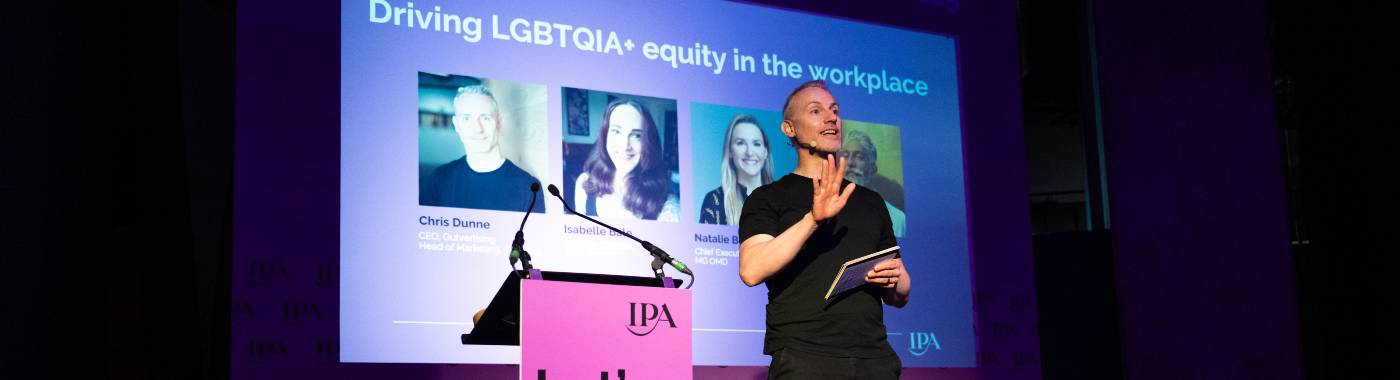
Industry leaders urged the audience to take action on inclusion at the IPA Talent & Diversity conference.

Recent rollbacks in DEI have been well publicised. It is no secret that LGBTQIA+ people have been at the sharp end of the impact of inequalities and hate-fuelled headlines.
Last week’s Supreme Court Ruling on the ‘legal definition of a woman’ has stoked the fires of hate and left many feeling scared, uncertain about the future and ostracised. But the Supreme Court's ruling has not come overnight.
Over the past 10 years, the UK has dropped from number one to number 16 in the Rainbow Map, which lists the most LGBTQIA+ friendly places in Europe. “Rulings like this become a lightning rod for hate,” says Chris Dunne, Head of Marketing at Thinkbox.
Asaad Shaykh, Head of Strategy at Grey London, Chris Dunne, Head of Marketing at Thinkbox, Isabelle Bale, Strategy Director, Europe at M&C Saatchi and Natalie Bell, Chief Executive Officer at Manning Gottlieb OMD, shared their insights at the IPA Talent and Diversity Conference. The panel discussion focused on how to push forward LGBTQIA+ equity in the workplace, in the face of an increasingly polarised ecosystem.
Doing something is always better than doing nothing.
Natalie Bell, Chief Executive Officer, Manning Gottlieb OMD
“As an industry, we are really good at selling dreams, but we are not that good at making them real,” says Shaykh. He notes that often we see LGBTQIA+ representation, but allyship needs to go further than representation. Now is the time to start doing.
Action comes in the form of providing employees with support. Policies like gender affirming medical care or transition policies are a great place to start. Yet, Bale also spotlights the importance of authenticity. Asking the audience if they are confident that their clients aren’t funding or supporting hate, she stresses that without knowing the answer to this question, we cannot begin to truly contribute to a safe ecosystem.
“Activism is fuelled by passion, and sometimes that can let us focus on the haters. It is important to address them. But why focus on the unconvertibles? Focus on those on the fringes,” says Shaykh.
Discomfort and fear can often stop people from speaking up. Therefore looking at ways to quell the fears of those who really want to help can help to create a much larger impact.
“You cannot be absolute in advocacy,” adds Bale. She urges people to reflect and consider if they are happy with how they are showing up for LGBTQIA+ people and with how much they are doing. Instead of looking for perfection, she urges people to take more supportive actions. Bale urged the audience to understand what they can do on a personal level alongside what their limitations are to make the most impact.
“Understand, doing something is always better than doing nothing,” adds Bell. Advocacy is a personal journey that takes its toll. The onus cannot be on individuals only. Instead, it is important to set boundaries and find meaningful ways to make change on an organisational level.
Bell shares that inclusive behaviour training has been useful in ensuring that everyone within her business is able to learn. She shared the importance of providing employees with wellbeing support at a time of polarisation that has left many feeling strained or burnt out.
At a time when we need unity, the panel urged people to share policies with one another, follow through on their beliefs and ask the questions that continue to place LGBTQIA+ equity top of mind.
The Outvertising Advocacy Playbook is a great place to start to understand what meaningful actions can be made in the workplace. No matter seniority, company type or role, the Playbook aims to provide people with the tools to make change in their roles.
Find out more about the Outvertising Advocacy Playbook here.
Looks like you need to create a Creativebrief account to perform this action.
Create account Sign inLooks like you need to create a Creativebrief account to perform this action.
Create account Sign in