Hot Pick
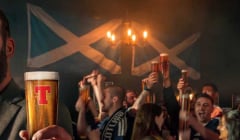
Tennent’s dreams of Scotland’s World Cup
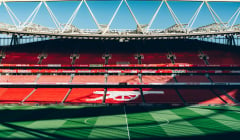
The campaign celebrates Scotland’s participation in the men’s World Cup group stage for the first time in 28 years.
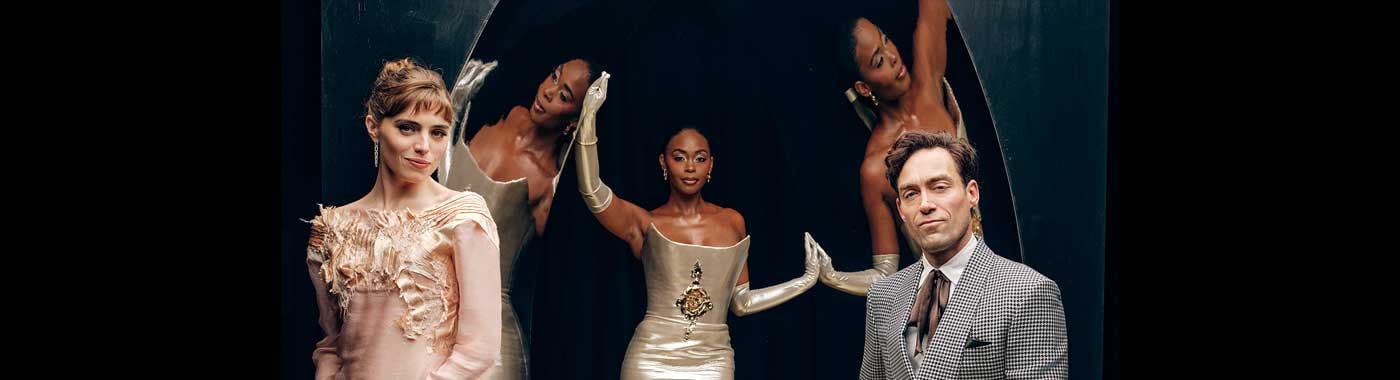
Photographer Sane Seven lifts the lid on this year’s BAFTA portraits and shares how creativity can thrive in chaos.

The polished BAFTA portraits people see online are actually made in a chaotic, high-pressure production machine where you may have one minute to turn a celebrity, a winner, or an exhausted performer into an image that stops people scrolling.
This year, my partner Marius Seven, who is a creative director, and I created the portrait studio for the BAFTA TV Awards inside the Royal Festival Hall. The concept revolved around large bent mirrors that distorted and fragmented reflections in subtle ways. It was ambitious because we had very little time to experiment, no certainty about how the mirrors would behave under pressure, and a constant stream of people moving through the set all night.
What people perhaps do not realise is the scale of precision behind the BAFTA photography operation itself. Every movement is timed. Every transition is coordinated. Hundreds of details are quietly managed to create a system where creativity can somehow exist inside complete chaos. It is an extraordinary machine built by people who genuinely care about image-making.
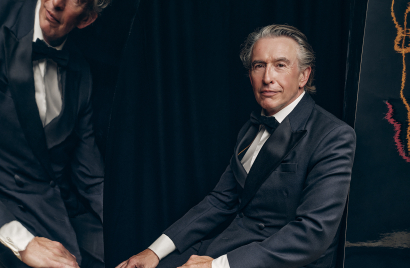
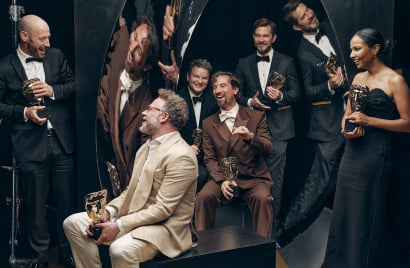
Hundreds of details are quietly managed to create a system where creativity can somehow exist inside complete chaos.
Sane Seven, Photographer
The shoot moves at a speed that is difficult to explain unless you have experienced it. You do not really think anymore. You react.
There is usually somebody from the BAFTA team standing nearby, counting down the remaining seconds. ‘Ten seconds left.’ ‘Thirty seconds.’ ‘Last shot.’
Ten seconds suddenly becomes a very long time.
People imagine celebrity portraiture as glamorous and controlled. In reality, it feels closer to live performance or competitive sport. Your body starts making decisions before your brain catches up. Fear, embarrassment and tiredness disappear. Adrenaline replaces all of it.
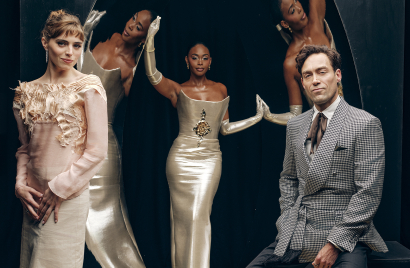
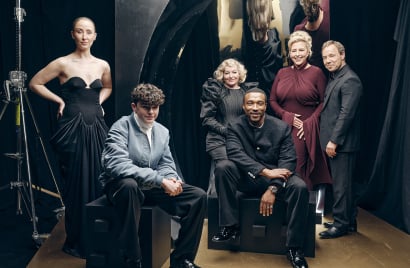
Most people, regardless of status, still want reassurance that they look good, that they are understood, that they are safe.
Sane Seven, Photographer
One minute the set is empty. The next, somebody like Steve Coogan, Awkwafina, or Seth Rogen with The Studio cast and production team walks through the curtain and asks: “Where do you want me?”
And you need to know instantly.
Some arrive nervous. Some are excited. Some are emotionally exhausted from the ceremony itself. Others enter with complete control over how they wish to be perceived. Most people, regardless of status, still want reassurance that they look good, that they are understood, that they are safe in front of the camera.
That first test frame becomes psychologically important. I always show it to the talent. There is nothing more intimidating than standing in front of a camera without understanding what the photographer sees. The moment they see the image and trust the direction, everything changes. Even under severe time pressure, they suddenly want to collaborate.
One of my favourite moments this year happened with Stephen Graham after his win. We began with calm, controlled portraits, probably assuming that the introvert in him would prefer something direct and understated. Then suddenly, something shifted. He stood up holding the award.
“I’ve just won a f* cup,” he shouted in his Liverpool accent, which felt so familiar after the ten years I spent there at the beginning of my career.
“It’s too civilised!” he shouted, roaring like a lion.
It was completely spontaneous. My only thought was whether the focus would hold.
Those are the moments you cannot manufacture.
The challenge becomes even more intense with group portraits. A room full of famous people can quickly collapse into something visually stiff, like a family photo. You are thinking about body language, hierarchy, shape, clothing, balance and energy, all within seconds.
Technical perfection is no longer enough.
Sane Seven, Photographer
What fascinates me most is how much contemporary portraiture now exists inside the attention economy. These images are consumed unbelievably fast. We are all scrolling constantly, absorbing faces in fragments. So the question becomes: what makes somebody stop?
Technical perfection is no longer enough. There has to be emotional tension inside the frame. Something unresolved. Something human underneath the performance.
That is partly why the mirror concept felt right for television actors. Actors permanently exist between multiple identities: public and private, character and self, performance and reality. The mirrors reflected that instability, the strange reality of having an image that belongs as much to the public as it does to you.
Outside the room, there are publicists, stylists, assistants, hair and make-up artists, producers, and waiting talent packed tightly into corridors. Inside the room, you have perhaps forty seconds to create something meaningful before the next person enters.
Despite all the machinery surrounding celebrity culture, people have the need to be seen.
Sane Seven, Photographer
There is no time to process anything. During the shoot itself, I feel almost euphoric, hyper-focused to the point where hunger, exhaustion, and time disappear completely. Then the final person of the 120 who appeared before the lens leaves, the adrenaline drops, and the body collapses into exhaustion.
But perhaps what stays with me most is this: despite all the machinery surrounding celebrity culture, people have the need to be seen. Even for a fraction of a second.
Maybe that is why portraiture still matters.
Sane Seven is a London-based portrait photographer known for psychologically charged portraits of influential figures across entertainment, politics, business, and culture. She has photographed cover stories and major editorial commissions for publications including The Sunday Times, Time, Forbes, and Harper’s Bazaar, and is particularly recognised for photographing women in positions of power with a sense of presence, strength, and emotional honesty.
Looks like you need to create a Creativebrief account to perform this action.
Create account Sign inLooks like you need to create a Creativebrief account to perform this action.
Create account Sign in