Trend
The best move is almost never reinvention, it’s loving what you already have
Georgina Leigh-Pemberton explains why brands should Love the Unmistakable.
Robert Jones urges the industry to tap into talent from Norwich and across the UK.

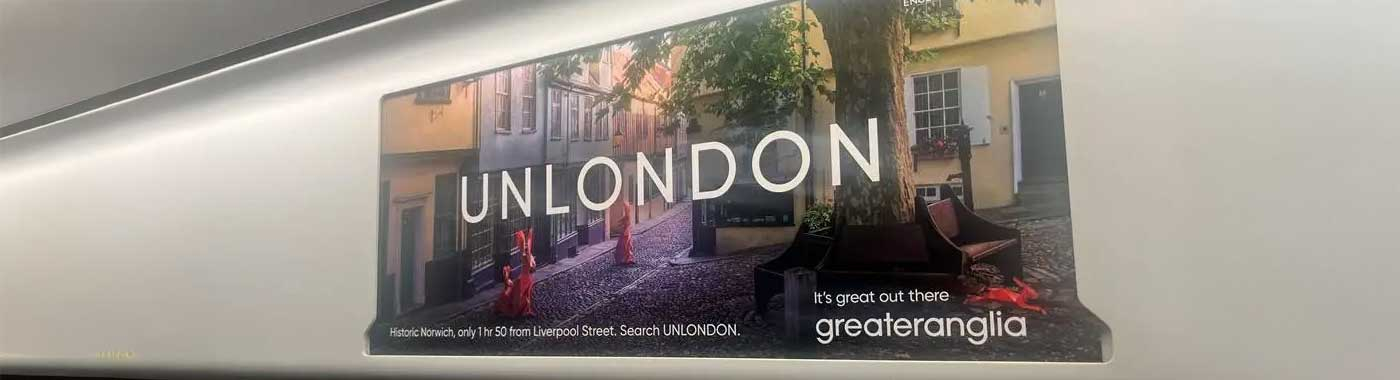
‘Unlondon’ is the slogan of a brilliant new campaign by Greater Anglia and Visit East of England to encourage Londoners to escape the city and explore the region.
But what if there’s a bigger thought here? Could there be an ‘UnLondon’ in the world of creativity? An alternative creativity from outside the capital? Agencies and freelancers with a different angle? A bigger pool of talent for CMOs to fish in?
We have new data that shows that – for one city, Norwich – that talent pool exists, and is growing. It’s just one way that the shape of the nation’s economy has shifted since lockdown – more than ever, creativity is distributed across the country.
The story goes back to 2020. In lockdown, I set up a network for people working in and around branding, in and around Norwich. I imagined there might be 50 of us. Five years on, we’re now called Brandland, and we’ve just ticked over 1000 people on our mailing list. So we’ve tapped into a real and unexpected interest in branding. We wanted to quantify this phenomenon, and we commissioned the economists at BOP Consulting to do just that.
Our research shows that the biggest segment of the whole creative economy in the Norwich region is branding. We define branding broadly to include all the specialisms companies use to build their brands – design, strategy, advertising, copywriting, digital, market research, PR, video. This is around a third of the creative economy locally.
People tend to think of the creative industries as the arts, film, gaming and heritage, all of which are vitally important. But actually branding is bigger.
And this segment is growing fast. In the Norwich region, branding jobs grew by 36% between 2018 and 2023, compared with 16% nationally. In the age of hybrid working, talent is choosing this area, on a massive scale.
So in Norwich, branding really is the engine of the creative economy. The research shows that there are now around 3000 branding professionals here, and almost 400 agencies (many of them probably micro-agencies). This is what economists call a cluster effect – there’s roughly twice the concentration of branding people here that you’d find across the country.
Why Norwich? Partly because we have a long heritage of branding. There’s an extraordinary collection of medieval merchants’ logos inscribed on historic building here. Big businesses started in the 1700s, many still around – Barclays, Jarrolds, Start-Rite. Colman’s mustard pioneered modern product branding here, back in the 1850s. Even the Rolo was invented here. Branding is in the soil.
Now, Aviva, Jewson, John Innes, Kettle Chips, Lotus Cars, Mattressman, Virgin Wines and many more are based here. Both our universities nurture creative talent: UEA is famous for creative writing, and Norwich University of the Arts has nurtured visual talent for decades. NielsenIQ Brandbank is based here. We even have Europe’s biggest brand archive, the History of Advertising Trust.
Our brand agencies include Ark, Sponge and The Click – whose work is recognised by Brand New. Borne are creative partners on a national stage, with clients like Fred. Olsen. BuxtonThreeTwo and Midday Studios work for food and drinks brands globally. Eye Film and Spindle are award-winning videomakers. Foolproof pioneered service design. Fountain Partnership is a Google-award-winning digital agency. In Development Studios chose to relocate to Norwich. KrowX is a customer experience agency, part of the Mission group. UnitedUs is Brighton-based, with a Norwich base too. And there are hundreds more.
And alongside these agencies, we have an extraordinary gathering of top-rate freelancers, including some of the industry’s most experienced strategists, and dozens of excellent copywriters.
Underlying all this, Norwich has a distinctive way of looking at the world. The city has always been a place of nonconformist thinking. It’s always welcomed a diversity of talent – including the ‘strangers’ who came here from the Low Countries in the 1500s to rescue the textiles industry. And from the 1000s to the 1800s, Norwich was Britain’s second largest city, with its own proud sense of identity as ‘a fine city’ – an alternative to London, an unLondon.
So Norwich is special. But I’m sure it’s not unique.
Emily Penny and Joel Stein recently analysed 150 of the top brand design firms in Britain. Of those, 47 are outside London (including The Click in Norwich). And they found that it’s the unLondon firms that have the most distinctive voices. ‘In particular, the well-known London agencies have familiar promises and language,’ they wrote in their report. ‘The emphasis is on transformation and change, the ideas are abstract, vague and impersonal.’ Maybe to get really personal, it’s better to look outside London.
Research shows that rising rents and remote work are driving a creative exodus from London and other major cities, transforming once-overlooked towns across Britain. While some of the most admired creative studios around the world are situated outside big capital cities, including Robot Food in Leeds, The Chase in Manchester and Thirst in Glasgow.
It’s good to see that the government recognises this phenomenon, and is investing across the country, with £380 million promised, plus (and this is a really neat idea) a champion for freelancers.
So why is all this happening? Maybe there’s actually a clearer view of the future from outside London. Business life is less frenetic, less epic, slower and more considered. Living costs less, and when there’s less financial pressure, people often feel there’s time to dream. And of course, London is a bit of a cultural bubble: maybe, to appeal to non-metropolitan consumers, you need a non-metropolitan worldview.
Of course, both London and unLondon are vital. Though I now live in Norfolk, I still find London constantly exciting and stimulating. But a nonconformist, unLondon climate could be a new stimulus to creative growth for the UK.
CMOs will increasingly look for agencies beyond the M25 – and they’ll find different perspectives, fresh attitudes, healthier working cultures, and maybe the future of creativity.
![Brandland 2[13].jpg.jpeg](/application/files/8517/5438/6843/Brandland_213.jpg.jpeg)
Robert Jones was head of strategy at the global brand agency Wolff Olins, and is now an independent brand consultant. He’s advised chief executives and chief marketing officers at global businesses like Aviva, Daimler, Tesco and Virgin. Alongside these big businesses, he’s worked with smaller companies like Faber, start-ups like FutureLearn, and not-for-profits like Historic Royal Palaces, Oxfam and Wikipedia. As an independent consultant, his clients include Aldeburgh Festival, Courtauld Institute of Art, English Heritage, LDA Design, London School of Economics, National Trust and Proper Snacks. Robert is also Professor of Brand Leadership at the University of East Anglia, and founder of Brandland, a network for people working in branding in the Norwich region. He’s written two books: The Big Idea (2008) and Branding: A Very Short Introduction (2017).
Looks like you need to create a Creativebrief account to perform this action.
Create account Sign inLooks like you need to create a Creativebrief account to perform this action.
Create account Sign in